Iron Mountain ski jump

Iron Mountain ski jump

Monday, March 14, 2022

AN INTERESTING DAY: Pooping dogs & crying women [M, 3-14-22]

CHRIST IN WINTER: Reflections on Faith & Life for the Years of Winter

So, I did two things in one morning that I haven’t done in a long time.

First, I slowed down and stopped because the man who was walking his dog was waiting at the crosswalk. No, that wasn’t the thing. I always stop when I see someone at a cross-walk, for the same reason I wear a mask during a pandemic. The “thing” was what the man did…


…he wanted to give me one of those friendly acknowledgment waves, the thank-you kind. As he and the dog started across the street, he waved at me with the hand that wasn’t holding the leash. I suddenly realized that he was waving a bag of dog poop at me! That’s sort of a mixed message. It was a big dog, too.

The second thing I’ve done often, but not recently. I made a woman cry.

I’ve done that a lot through the years, but the tears were usually from frustration or irritation. And I haven’t done it much at all for two years, since I’ve not been permitted out I public, where there are strange women who don’t know to avoid me.

I went to Morgenstern’s Book Store, to buy Helen a birthday present, and get a cup of coffee. I sat in an area where a woman was finishing up working on her computer. We got to talking, because she had some time to kill before picking up her granddaughter, and you can’t be masked while drinking coffee. She told me about something she has been wanting to do for a long time, and I told her it was time for her to go ahead and do it, that she was ready, that there was no reason to wait longer. When a person who looks as old as I do tells you to get busy before it’s too late, you have to take it seriously. She started to cry. She wiped away tears as she said, “Thank you. That’s what I needed to hear today.”


Among other things, I bought Helen one of those “What I Love About You” books, where each of the 50 pages starts a sentence but gives you a blank or two to fill out. Some of those, 
like “I love to kiss your _________” are surprisingly tricky to complete.


All in all, an interesting day.

John Robert McFarland


Saturday, March 12, 2022

ODDS & ENDS: Central column follow-ups; Out with Grandpa; Lent [Sat. 3-12-22]

CHRIST IN WINTER: Reflections on Faith & Life for the Years of Winter

 {Remember to set your clocks ahead.}

FOLLOW UPS TO THE 3-4-22 COLUMN ON TELEPHONE OPERATORS


Old college friend Bob tells of when he was in theological school at SMU, how he dated a Southwest Bell telephone operator named Marilyn a little, but then was gone for the whole summer. When he got back, he received a bill from Southwest Bell for several thousand dollars, which was to be sent to a particular operator, named Marilyn. He called her up and said that seemed like quite a lot, even in those says where long-distance calls were toted up by the minute, but he was willing to meet her in person to discuss it. He’s had a very smart wife named Marilyn for close to 60 years.  

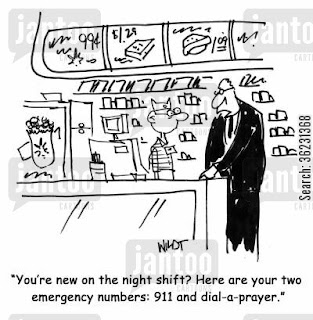
Faithful commentor, Maria, said that when she was growing up, their home phone number was very similar to Dial A Prayer. She says that “My dad often indulged folks.” How neat.

OUT WITH GRANDPA


Our grandson is coming to visit. I am delighted, and also a bit worried, for I am remembering the time when he was about three and wanted his mother to stop at the gumball machine on the way out of the grocery store. At that point, of course, any mother with a 3 year old and a 7 year old and a cart full of groceries simply doesn’t have time to stop. He started to tear up. His mother overheard his sister say, “Don’t worry about it. Just wait ‘til the next time you’re out with Grandpa.”

This worries me some, since now when he is out with Grandpa, we look at new sports cars.

AFTER THE CAMERA BREAKS AWAY


TV sitcom writers are smart. They’re not always good. Plenty of the stuff they try to put over on us as humor is lame, at best, but they know when to cut the camera away from the action.

It’s right after a character has said or done something stupid or embarrassing or awkward or dangerous. The laugh track comes up, and we’re left to write the rest of the scene for ourselves.

The real action comes after the camera cuts away.

Jesus had some pretty good writers—Matthew, Mark, Luke, John, Paul. But the real writer of the Jesus story is The Holy Spirit, who does the writing after the camera has cut away. When we have said or done something stupid or embarrassing or awkward of dangerous, the camera cuts away, and we’re face to face with the risen Christ.

That’s what Lent is all about.


John Robert McFarland

Thursday, March 10, 2022

VICTORY OF THE MOTHERS [R, 3-10-22]

CHRIST IN WINTER: Reflections on Faith & Life for the Years of Winter


Recently I have seen a photo of a train station in Poland, where Polish mothers have left a line of baby strollers for arriving Ukrainian refugee mothers. Unknown mothers understanding the plight of other unknown mothers. Just a simple little thing to make their desperate refugee life a little easier. It is an endearing and heart-rending picture.

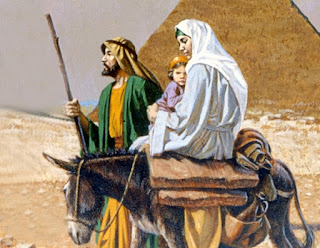
It makes me wonder if Egyptian mothers did a similar thing for Mary when she had to flee her country to escape a narcissistic megalomaniac who was bent on killing not only her son but all the other little boys under age two in his nation, just to hang onto his power, without any concern for the agony he was causing others. [Matthew 2:13-18.]

They didn’t have strollers, of course, and there were no instant forms of communication, but there was a large Jewish population in Egypt. They would have heard about Herod’s plans. Knowing that refugee mothers were coming with their children, perhaps they left reed baskets at oases. Or water skins. I hope so. I think so. It is what mothers have been doing for other mothers for as long as there have been babies, and as long as there have been men who are desperate for outward power, to cover up their inward weaknesses.

We know very little of Jesus until he was 30 or so. Imagine how many little acts of kindness other mothers must have done for Mary along the way. It may not take a village to raise a child, but it takes a lot of acts of kindness, one mother to another, some known, some anonymous. Acts that are not chronicled in the bible, not noted on a web site, not prattled on a podcast. Unknown acts from one mother to another, so that all can get their children raised up…

…up to where some can be saviors, and some can be destroyers.

Yes, there were other mothers who helped Vladimir Putin’s mother, too, shared some turnips or some rubles, or when things got bad enough, some vodka.

Many people claim that Ukraine will win this war. Because it should. That is the way the story is supposed to come out. But what does winning mean? Think of how many lives, how much property, how many works of art, how much culture, how much trust is being destroyed. Perhaps when it is “over,” Ukraine will continue as a free, democratic nation. Yes, that will be a victory. But a “broken hallelujah.”

I am not as optimistic. Russia is so large, and has so many resources, and it has a soulless dictator who has a lot of “face” at stake. That is the definition of “might makes right.”

But even if Ukraine is subjugated as a vassal state of Russia, Putin can’t win, either. Dictators never do. There are always too many mothers who are willing to leave a stroller for the next refugee mother who comes along.


johnrobertmcfarland@gmail.com


Tuesday, March 8, 2022

REBOOTING FOR A POST-COVID WORLD [T. 3-8-22]

CHRIST IN WINTER: Reflections on Faith & Life for the Years of Winter

Now is the time to work on how we are going to restart when the virus and masks and isolation are gone. Yes, it seems a bit early. They are not gone quite yet. Maybe they won’t be gone entirely forever. But a restart of some sort will come, and we need to make decisions about it rather than just letting it happen any old way. “Any old way” is not a restart; it’s just chaos.

If there is anything good about this covid-induced shutdown and isolation, it’s the chance to reboot, individually as well as socially. We have a better idea now, if we’re paying any attention at all, about what is really necessary to have a whole life.

I once tried to get my conference to restart, but that did not work, for a lot of reasons. The main one, though, I think, was that the underbrush had not been burned off far enough for people to see the need. The covid19 virus has burned off a whole lot of underbrush.

A conference, in Methodist terms, is a geographical area. All the preachers, congregations and other ministries [hospitals, retirement homes, children’s homes, colleges, etc] belong to the conference. My membership was in The Central IL Conference, now part of The IL Great Rivers Conference.

It was almost 40 years ago now. As always, everybody had been moaning and groaning about the dearth of new people joining our congregations. I figured that the reason for that was simple: nobody ever invited anybody to come. We had lots of meetings to figure out what to do about it, but that was all we did—meet and talk.

So I made a motion at annual conference [the annual meeting of all the preachers and lay members, same number of both clergy and lay voting members] that we have no meetings for a year and instead spend the time we used for meetings for inviting people to join the church and come back at the next annual conference and see if we were better or worse off as a church.

Somebody got up and acknowledged that my motion was a fun way to bring attention to the problem… but Bishop Hodapp said, “No, we have a legitimate motion before us and we have to treat it as such. We can’t talk about it until it gets a second.” It immediately got a whole lot of seconds.

Nobody wanted to admit that they thought meetings were a better use of time than asking people to join the church, so they began to drag their heels in little ways…

Well, the conference trustees had to meet, in case we were sued because some preacher was a pedophile, or to deal with the insurance company in case the conference office building blew up. So I accepted an amendment to my motion to allow the trustees to meet.

Well, the Episcopacy [bishop] Committee had to meet, in case the bishop died and we got a new one. I accepted the amendment.

Well, there might be an emergency with the broom committee, or the rearview committee or… you get the idea. Even with all the amendments, the motion lost, but not by much. They just could not take a chance on change.

A few years ago, a conference administrator said to me, “To show how bad things have gotten, we’re beginning to take seriously ideas you suggested twenty years ago.”

That’s fine. It makes me feel affirmed. But my ideas were all about re-starting a church that no longer exists. We all had ideas before covid about how we should reform our lives. Those ideas are irrelevant now.

Yes, old people don’t have many years left, but we need to start working on how to live those years in a post-covid world. As Barbara Sher says, “It’s not too late unless you don’t start now.”

John Robert McFarland

Sunday, March 6, 2022

THE IMPORTANCE OF “CENTRAL” [Sun, 3-6-22]

CHRIST IN WINTER: Reflections on Faith & Life for the Years of Winter

For some reason [it’s money, stupid!] America is set on eliminating people from commerce. Be it producing raw materials, using them in manufacturing, or selling the products, the ideal is “untouched by human hands.” The theory is: Anything people can do, machines can do better, and cheaper. There are gains, perhaps, economically, but we pay a high price socially.

Especially confounding is the loss of the telephone operator known as “Central.” That’s how she answered when you turned the crank and rang her up, just that one word, “Central.”

When Helen was about two, she cut off a leg. Well, it was something serious like that. Her mother grabbed the phone and yelled, “Call the doctor and call my mother” and hung up to attend to Helen. Very soon running up the walk were Dr. McClure and Lara Heltzel. “Central” had recognized Georgia’s voice and knew who her mother was and which of the town’s two doctors attended their family.

One day my mother called Central in Francisco, IN and asked for Dill’s store. “Do you want to talk to Johnny or Ted?” Central asked. “I think Johnny’s still there, but Ted just left.” Her office was across the street from the store.

Then there are people who are not designated as “Central,” but who do the work anyway…

Daughter Katie saw a tweet about a guy [apparently in England] whose father has a telephone number similar to that of the train station. He often gets calls asking about train schedules. It costs people to call, and he doesn’t want them to lose their change, so he just got a copy of the train schedule and looks up the next train to nowhere [actually, Katie said “to Bristol”] himself instead of telling them they have the wrong number.

When we lived in Arcola, IL, every September a man called wanting to talk to Phil Yoder. There were lots of Yoders in that Amish-laden area, but we knew of no Phil. The caller and Helen always had a nice conversation about Phil’s continuing absence from our house, but they had nothing else to talk about, so Helen finally just got Phil’s number herself so she could give it to the guy.

When we lived in Normal, IL our number was just one digit different from the IL State U office that handled both the university police and janitorial services. Unfortunately, one of their shifts ended at midnight, and I often got calls around 1:30 in the morning from women wanting to know “where in the hell is my husband?” I did quite a bit of wee hours marriage counseling on the phone.

When they lived in Gary, IN, Helen’s family often got a call from a man who whispered, “Is he gone yet?” Her mother got fed up with it and said, “Yes, come on over.” Then she got to worrying and watched the newspapers for days for reports of knifing incidents. There were so many, though, that she wasn’t sure if the man she had invited over was one of them.

Life is so much easier with a Central.

Every family, every group, every organization needs a “Central.” They may not be called that, but that’s what they are. Today is Helen’s birthday. I’m so grateful that my life still has a Central.

johnrobertmcfarland@gmail.com


Friday, March 4, 2022

ODDS & ENDS: Eating Snakes, Dolly Parton, & Loving Kindness [F, 3-4-22]

CHRIST IN WINTER: Reflections on Faith & Life for the Years of Winter


EATING SNAKES

I think I forgot to relay this story when Katie Matson first told us. She is a nutritionist, and before retirement worked in the health service at Indiana University. It’s a neat program. Any student can have a free consultation with a professional nutritionist to get help with eating problems. A grad student from a Middle East country came to see her.

“My problem is snakes,” he told her. “I love to eat snakes.”

Katie was non-plussed. She has a Master’s degree and years of experience, but had no idea about the nutritional value of snakes.

“I know I should not eat snakes,” he went on, “but I love them so. I eat them all day long.”

Katie began to wonder where he got all those snakes. Bloomington has a lot of ethnic groceries and restaurants, since we have IU students and permanent residents from all over the world, but…

“The worst is, eating snakes at bed time. I know that’s the worst…”

Then poor Katie breathed a sigh of relief. His English was very good, but he did have a bit of accent. What she had been hearing as “snakes,” he was saying as “snacks!”


LOOKING WITH DOLLY

I saw an interview with country singer Marty Stuart about Dolly Parton, the voluptuous philanthropist. [When was the last time you saw those two words together?]

He said, “Dolly isn’t a dumb blonde. As she herself has said, ‘I know I’m not dumb, and I know I’m not blonde.’ She looks like that to get you to look at her. She knows what you’re thinking when you’re looking, so she’s able to pull you over to her side, so that you’re no longer looking at her, you’re looking with her.”

I think that’s what Jesus does. Jesus knows what we’re thinking, and he uses that knowledge to pull us over to his side, to see with him, to see the world as he sees it. We call that salvation.


LOVING KINDNESS

I usually have half a slice of homemade bread with peanut butter for breakfast. This morning I decided that I am old enough to have jelly, too.

I have avoided jelly heretofore because I have diabetes. My doctor says that my diabetes is “well controlled through medication,” which irritates me, since I think it is controlled because I walk so far every day, and also do not eat jelly on my toast.

But, I just had a birthday, and when you’re this old, how many years am I cutting off my life by having a little jelly? Anyway, it reminded me of one of my favorite sermon illustrations…

A Sunday School boy was asked to define loving kindness. He said, “If you ask someone for a piece of bread, and they give it to you, that’s kindness. If they put jelly on it, that’s loving kindness.”

John Robert McFarland


Wednesday, March 2, 2022

THE SCOPE OF S.C.O.P.E. IV: THE WAGONMASTER [W, 3-2-22]

CHRIST IN WINTER: Reflections on Faith & Life for the Years of Winter

The fourth of a four-part series for Black History Month]


I drove the nuns and students of our Terre Haute SCOPE chapter to Atlanta for their orientation at Morris Brown College, before their assignment to Albany, so they could have Dr. Justin’s station wagon, then flew home. In his first report letter back to Terre Haute, Bob Mullins said that the group all agreed that they would miss me “…because his religious jokes are an inspiration.” It’s hard to interpret that now…

Bob was both serious and fun. Everyone at the Wesley Foundation [Methodist campus ministry] liked hanging out with him. But he was not musical. So it was a source of much merriment among his fellow WF students back in Terre Haute when we learned that, among all his other duties as de facto leader for the Terre Haute Scope chapter in Albany, Georgia “freedom summer” of 1965, the Golden Notes gospel singing group had decided he should be their manager.

Singer, no, but manager, definitely yes. Bob was a remarkable twenty-one-year old. He was not fazed by dealing with the business of running the Freedom School, and finding lodgings for the nuns and the students, and even being the manager for the Golden Notes, even though he thought that his only job that summer would be working on voter registration.


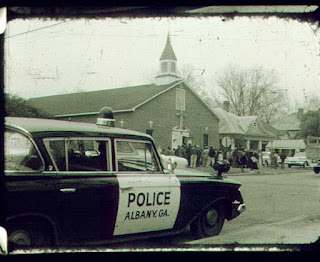
It was a little more onerous to deal with the constant harassment of the police than to manage the Golden Notes. He was arrested almost daily for imaginary driving infractions, such as incorrect changing of lanes. The fines ranged from $17 to $30, which in today’s dollars would be like $170 to $300. He didn’t have to pay those personally. Those fines were paid by SNCC [Student Nonviolent Coordinating Committee, the sponsors of Freedom Summer] or those of us who raised funds back home. [There were 7 clergy-Catholic, Protestant, and Jewish-- in Terre Haute who together raised about $3500 to finance the trip.]

The two things that really did bother Bob were the apathy of the local “Negroes” in Albany, and the ignoring of journalistic ethics by the Southern newspapers.

In their final report, Sisters MJ and AL said that they largely failed at getting local Negro leadership involved with the Freedom School and the voter registration, especially the “middle-class Negroes.” It’s just the way it is; middle-class folks have the most to fear when change comes.

Bob was a journalism major at Indiana State and sent back articles on what he was doing that summer to “The Statesman” INSU newspaper. He was appalled that the newspapers throughout GA and AL referred to black people, as “niggers,” not just in opinion columns but in news articles.

One of his trickiest incidents came one night when he was eating by himself at a restaurant and a girl he described in his letter only as “very young” propositioned him. He said that she was persistent, and he had to be careful how he rejected her overtures, or he would be considered rude, for she was black.


Bob went with the expectation that he would just be another student, spending his time registering folks to vote. Instead, of necessity, he became the wagon-master, especially of Dr. Justin’s station wagon, but also doing all the things the wagon-masters of the old West did—scouting out the way, looking for water holes, finding grub, leading the way on the river fords, watching for hostiles.

I was so busy back then, as a son and husband and father, as a pastor, that the fullness of one day just ran into the next. I didn’t have time to stop to consider what an extraordinary thing our SCOPE chapter was doing, and what an extraordinary young man was leading them. It’s nice now to think about that.

Also, I have been rather stupid as I hear people say that they don’t think this “history” should be taught. “This isn’t history!” I rant. “This is life.” But then I realize that for anyone under the age of 65, and that includes most state legislators, this IS history. To me, it is what we did only yesterday, to try to be decent people.  

John Robert McFarland

johnrobertmcfarland@gmail.com