Iron Mountain ski jump

Iron Mountain ski jump

Monday, February 28, 2022

THE SCOPE OF S.C.O.P.E. III: THE CITY [M, 2-28-22]

CHRIST IN WINTER: Reflections on Faith & Life for the Years of Winter: 

[Third of a four-part series for Black History Month]


Albany, Georgia in 1965 had a population of 90,000, about 38% black. Early in the summer, Sisters of Providence Mary Jean Mark and Alma Louise Mescher made the rounds of merchants in town, getting donations of chairs and paint and tubs and buckets and other items the Freedom Center needed. The SCOPE folks were pleased that white merchants would be so generous, especially considering why the Freedom Center was there, so that black folks could be full citizens.


Turns out that all some people saw when a nun approached in those days was the full black habit. “Those habits got things done that other people couldn’t do,” Bob Mullins said. The nuns were always in full habit in those days.

The full black habit was one reason SNCC thought the nuns would not last two weeks. Albany in summer is 90 degrees of heat and another 90 of humidity. Those black habits were heat catchers without ventilation. And little children, wearing almost nothing because of the heat, made it worse by constantly running up to them and hugging their legs and hanging on their arms.

Physical discomfort, though, meant nothing to those Sisters of Providence. The local Catholics offered them space in a convent, but that would have taken them out of the ghetto where they were working. They knew they had to live with the people they were serving. They stayed in the falling-down building with the broken windows.


Those black nun habits were especially useful when they encountered “the Albany system,” that gave the city a false reputation for racial progress. The Albany system was to wear people down with constant harassment. For instance, Georgia did not require folks who were going to be there for only ten weeks in the summer to get new car license plates and driver’s licenses, but Albany did. SCOPE workers and local demonstrators were arrested regularly, sometimes more than once a day. The SCOPE workers were not a big problem. They were white. Bob Mullins just went down to the jail and paid their fine.


Black demonstrators were a different problem. The sheriff didn’t want to let them out, and often sent them to jail in other counties. In one instance, some demonstrators were arrested “for blocking the sidewalk” while picketing a grocery. Some were as young as eleven. They were kept in jail. Their parents found out they weren’t being fed and took food to the jail. The sheriff wouldn’t let them in. So the aptly named Sisters of Providence took the food to the jail. The sheriff took one look and decided he didn’t want to deal with the fallout from them. 
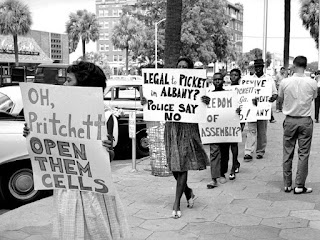


They local newspapers praised the Dougherty County sheriff for his handling of the “nigger demonstrators problem.” [Yes, the newspapers referred to black folks as “niggers.”] He described “the Albany strategy” as “meeting non-violence with non-violence.” He just arrested anyone who looked like they might be about to demonstrate and sent them to jail, often in other counties.


The strategy was not to do violent things that could be reported in the northern media, but to do minor things that seemed like cooperation when people were looking, and do lots of harassment in private—arrests, fines, isolation, hunger, bureaucratic nonsense—the rest of the time.


And Albany was considered racially progressive in 1965!

John Robert McFarland


Saturday, February 26, 2022

CHRIST IN WINTER: Reflections on Faith & Life for the Years of Winter

THE SCOPE OF S.C.O.P.E. II—THE NUNS [Sat, 2-26-22]

[The 2nd in a 4 part series for Black History Month. Be warned—it’s twice as long as usual.]


[Sisters Alma Louise Mescher and Mary Jean Mark in Albany, GA in the summer of 1965]

I met Sister Mary Jean Mark first. She taught history at the Catholic girls’ college, St. Mary of the Woods [SMW], a few miles west of Terre Haute. It was the time of Pope John XXIII’s Second Vatican Council, which he had called in order “to throw open the windows of the church and let the fresh air of the Spirit blow through.” To do that on the Terre Haute level, Sister MJ was tasked with providing an evening of ecumenicity for her colleague teaching nuns and their students. Since I was the new Methodist campus minister at Indiana State U and Rose Poly Institute [now Rose-Hulman U], she invited me to speak to the assemblage, to provide them with the perspective on the church and world for all of Protestantism. It took me about twenty minutes. But the Sisters of Providence became our friends personally, and our colleagues in higher ed ministry and social justice professionally.

In a note much later, Sister Alma Louise said, “Since I have gotten to know you, I understand why Sister MJ treasures your friendship.” That was delightful to hear, because MJ and I were buddies, despite the great differences in our ages and theologies. I think it was helped early on by then three-year-old Mary Beth, who answered the phone one day when I was indisposed and Helen was gone. To my dismay, I heard her saying, “Now you just wait a minute. He’s on the potty, but you just wait…” By the time I got to the phone, I heard this hysterical laughter coming out of the mouthpiece. It was Sister Mary Jean. She was the first nun I ever met, and I was probably the first Methodist minister she had met, and, yes, we did treasure each other. 

When the SNCC [Student Nonviolent Coordinating Committee] asked for help for the 1965 “Freedom Summer,” to register black folks to vote, we had both Wesley Foundation students and SMW students and nuns who wanted to be part of it. Sisters Mary Jean and Alma Louise, went, along with our Wesley Foundation kids, headed by Bob Mullins, an IN State U journalism student from Hammond.

Nuns were not respected outside their own precincts in those days. They were women. They wore funny clothes and didn’t have sex and weren’t allowed to drive cars. How could they know anything about the world?  Also, they were old, especially in the radical slogan of the day, “Trust no one over thirty,” and SNCC was a youth movement.

Mary Jean was in her 60s and Alma Louise was 49. Two highly competent women, old enough to be mother or grandmother to Bob Mullins, but not even allowed to ride in a car with him, or any other man, including Sister Mary Jean’s brother, unless there was a chaperone.

MJ and AL were college professors. Sister Alma Louise [nee Marjorie Anne] had a PhD from Notre Dame and was a research biologist who had mosquitoes bite her own arm so that she could study the effects. But they didn’t count for credibility, because they were just women, and the most out-of-it women of all, nuns!

So Bob Mullins, age 21, was the head of the group, renting a headquarters [229 &1/2 S. Jackson] and sleeping rooms, and managing the budget and shopping, and getting chased and shot at. He was the escort and body guard for the nuns and the girl students. It didn’t strike me as unusual at the time. I was doing that sort of thing at 21, except for getting shot at. Now I realize how remarkable Bob was. And how remarkable those nuns were.

Nuns were always in full habit in those days. Later Sister Mary Jean was much distraught when they “came out of the habit.” It wasn’t really “out” at all, but it seemed so to Sister MJ. The St. Mary of the Woods Sisters of Providence got full habits in dark blue and light blue as well as black. That was their idea of “modernizing.” Sister MJ said, “It’s just so hard. Every morning I have to decide which color to wear.”

Sisters Mary Jean and Alma Louise told me in a letter how the local “Negro” undertaker had asked them to take food to their grandson in jail. He and a dozen or so of his friends had been arrested for picketing a super market. Those arrests were usually of the “blocking the sidewalk” type. The undertaker, Mrs. Barnum, was sure they were not being fed in the jail. When the nuns went to the jail, they found out that she was right. Her grandson was eleven years old!

They returned to the jail with food. Not even the sheriff was foolish enough to turn those habits away. Yeah, those nuns were fragile, wouldn’t even last two weeks, the SNCC folks said.

They were the only nuns to participate in SCOPE. “Look” magazine did a five-page spread on them.

Many years later, when nuns were out of the habit, I was at some conference and spied a woman across the room. She was wearing a nice dress and high heels. And a neck cross.  I went up to her and said, “You’re a Sister of Providence, aren’t you?” “Yes,” she said. “How in the world did you know?” “That cross,” I said. “Only SPs wear one like that. Also, you don’t look like someone to underestimate.”

John Robert McFarland

Thanks to good friend and Emeritus IU professor Dr. Anthony Mescher for research on Sister Alma Louise Mescher.


Thursday, February 24, 2022

THE SCOPE OF S.C.O.P.E. I: THE PROJECT [A column for Black History Month.] [R, 2-24-22]

CHRIST IN WINTER: Reflections on Faith & Life for the Years of Winter


Renata Justin, a Terre Haute MD, loaned her station wagon to our SCOPE Chapter for its voter registration work in the freedom summer of 1965 in Albany, GA. Twenty-one year old IN State U rising senior, Bob Mullins, the summer driver, was afraid to face her when they returned. The wagon was punctured with several bullet holes, the result of a chase by a bunch of rednecks in a pickup truck. “I’m afraid the pistons are probably shot, too,” Bob confided to Dr. Judson. “I was pushing it pretty hard.” Dr. Judson said that she would take care of the pistons, but the holes would remain. “I want everyone to see them," she said. "I want people to know.”

The Indiana State Legislature today would probably make her cover up those bullet holes, because their reality “would make people uncomfortable.” That’s the reason they are trying to pass a law that not only can parents opt their children out of any “uncomfortable” history and social studies lessons, especially about race, they want to make it illegal for teachers to teach those lessons in the first place.

In fact, Sprunica Elementary School, in Brown County, Indiana, has gotten a head start by telling parents that they can opt out of letting children read this column. Well, not exactly. They’ve told them they can opt out of all black history lessons, and this column is the start of a black history lesson for Black History Month. [After sending a letter to parents announcing that policy, they have now backtracked on it.]


John Lewis founded The Student Non-Violent Coordinating Committee [SNCC] in 1960 to further the civil rights movement that so many people, including state legislatures, now want to ignore. Throughout the South, the written and unwritten laws insisted on “separate but unequal,” and, especially, no voting by black people.


SNCC went about the work of voter registration throughout the South through a project called SCOPE. SCOPE was short for “Community Organization and Political Education.” Students on many university campuses founded SCOPE chapters, to send students South to participate. That included The Wesley Foundation [Methodist campus ministry] at Indiana State U, and students and nuns from St. Mary of the Woods College, who formed a Terre Haute chapter.

So it was that we had gathered at St. Mary of the Woods in June of 1965 to send off six students and two nuns to spend the long, hot summer in Georgia, registering black folks to vote, and teaching illiterate adults to read so that they could be informed voters, and trying to get children from inferior schools caught up with their white counterparts. I was holding two-year-old Katie in my arms as the priest came along, shaking a censor of holy water on everybody present. The highly indignant Katie made a great show of wiping the holy water off her Methodist personage. That got a great laugh from all the nuns, which only encouraged her.

With the students from all the other university chapters, our nuns and students spent a week of orientation at Morris Brown College, in Atlanta, and then were sent to Albany, Georgia. SNCC thought it would be the easiest place, because Albany had a reputation for forward thinking about race relations, at least compared to the rest of Georgia, and because “those nuns won’t last two weeks.” Boy, were they wrong! About Albany, and especially about those nuns!


John Robert McFarland

This is the first of a four part series for Black History Month, remembering the Terre Haute Chapter of SCOPE, in special defiance of all those who want us to ignore and forget the history of race relations in this country.


Tuesday, February 22, 2022

ALL THE LIGHT WE DO SEE [T, 2-22-22]

CHRIST IN WINTER: Reflections on Faith & Life for the Years of Winter


Ray Judd was a distant cousin of my mother. Ray was a judge, which I thought rather neat. He was “Judge Judd.” That could be happily confusing. Even at twelve, I loved language play.

We lived in the country, without modern conveniences, like in-door plumbing and air-conditioning, but one hot summer night, Ray and his wife, Dorothy, made the trip to have supper at our house.

Yes, we were poor and non-convenienced, but in the summer we ate well, because of our huge garden, and chickens that sacrificed their eggs and their lives for us. And Mother was a good cook. It was worth the drive and the sweating.

Ray and Dorothy did not come alone, of course, because they couldn’t drive. Both were blind from birth. So their two tall, handsome, late-teen sons, Russell and Donald, were with them. Russell was the eyes for their mother, guiding her through our yard and into the house and onto a chair. At table, he filled her plate and told her where each item was. Donald did the same for their father.

From the time the boys were little, they had just fallen into that routine. Russell was the interpreter for their mother, and Donald for their father. They interpreted the world of sight to those blind parents. I was fascinated by that.

My father was almost blind, and Mother saw the world so differently from others that she needed an interpreter. I was only twelve when the Judds came to our house, but I already felt that I was responsible for interpreting for my parents. I wanted to know how Russell and Donald did it, and so well, so seamlessly. Could I do that?

Of course, my parents wanted to know how two blind people managed to raise two children, and do it so well. But that was old-hat to Ray and Dorothy. They just brushed it off. “It got easier when they could talk,” Dorothy said, “because they tattled on each other.” Russell and Donald pointed fingers at each other, and Dorothy said, “I can see you,” which got a good laugh from everyone, especially those boys, but I wasn’t quite sure where the funny was. Being an interpreter for the blind seemed rather overwhelming to me.

I’m sure Mother must have kept in touch with Ray and Dorothy in some way after that, but I didn’t ask her about them, or those impressive sons. I was starting the teen years. I had so much “me” to interpret. Then I became a preacher. I had so much “you” to interpret. Then I got married, and had children. I had so much “us” to interpret.

I’ve thought often, though, about that one night, seeing those boys interpreting the world of sight to their parents. I began, even then, to realize that we are all blind in some ways. We need people who can interpret to us the world we cannot see. And we need to interpret all the light we do see, to others.

Physical sight often fades in old age, but we still see light that others do not, and the world needs our interpretations.

John Robert McFarland

Since I like coincidental numbers [see my column on the odometer of my first car turning up 55555.5 miles] I should make something of this being 2-22-22, but… I’ve got nothin’.


Sunday, February 20, 2022

ODDS & ENDS: Brain Science, Living Books, Heroes, Legalistic Churches [Su, 2-20-22]

CHRIST IN WINTER: Reflections on Faith & Life for the Years of Winter


YOUR ANTERIOR CINGULATE IS FULL OF PREVENIENT GRACE.

How’s that for combining the least comprehensible words of brain science and theology? Perhaps incomprehensible, but true. [1]


TOO NORMAL FOR THE LIBRARY

I am just so normal that they won’t even let me be a human book! Our local library is catching onto the “human book” idea, where a “reader” can “borrow” a person for a conversation, to learn first-hand about their lives.


This being Bloomington, though, the local library wants you only if there is something about you that other people consider abnormal, like being a transgender person, or an amputee, or a felon, or an addict or an ethnic. The idea is for these conversations to challenge stereotypes. Well, “straight old Methodist curmudgeon?” I’ll bet that’s a stereotype to lots of people. They have no idea just how straight and curmudgeonly I can be!


WHAT IF YOU DON’T LIKE THE BOOK?

Our librarian/author daughter decided she would volunteer for one of those thirty-minute sessions as a living book in her town. One of her “friends” asked, “Can I take you back early?”


THE WIND BENEATH MY WINGS [AND IN MY FACE]

Our February weather has been up and down, zero for a couple of days, and then 60 for a couple. Today it was zero. I walked by a house where a thirtyish woman came out in non-outdoor clothes to fill her bird feeder. She saw me trudging into the wind and called, “You’re my hero!” That was nice. Of course, as soon as she went back in, I turned around and went home, because it was SO cold, and I’m sort of a cowardly hero. Still make me smile when I think about it, though.


CHURCH AS LEGAL SYSTEM

We had to go see Father Thomas Kovatch, the priest at St. Chuck’s RC Church, to answer questions about our older daughter, to prove that she exists, so that she can get married in an RC church up in “Da Region.” [Gary-Hammond and environs] I asked if he couldn’t ask the questions over the phone--so we could avoid going out in public, because Indiana is full of anti-vax, mask-less people--because it was just stuff like “Is she baptized?” but he said no, their canon lawyer said these are legal forms, so we had to answer the questions in person. I’m glad we got to meet Tom [He said I could call him that.]. He’s a nice guy, and a fellow IU alum. But there is something wrong when a church becomes a legal system, like the Roman Catholics and the Amish and the Methodists.

John Robert McFarland

If you’re not too busy checking living books out of the library, try How God Changes Your Brain, by Andrew Newberg, MD, and Mark Robert Waldman.

Friday, February 18, 2022

A PERFECT BAPTISMAL RECORD [NOT] 2-18-22

CHRIST IN WINTER: Reflections on Faith & Life for the Years of Winter


I love babies. If I had started as a Baptist preacher, I would have had to go over to the Methodists so that I could baptize babies.

I loved baptizing babies. I would hold the baby in my arms while I put the water on its head and “said the words” over it. Then I would walk up and down the aisles with the newly baptized baby, so that all in the congregation could see it up close, and I would say: “This is the newest member of the Body of Christ. This child is now our responsibility. When it doubts, we must help it trust again. When it is sad, we must help it laugh again. As it grows, we must push it forward, but if we see it going to close to the edge, we must pull it back to safety. This child is baptized. This child is our child.” [1

Sometimes I thought about just going on out the back door. Just leave all those other people back there in the church while the baby and I had a good time. Then I would remember that a diaper change would be coming up, so I handed it back to its parents.

I baptized babies over a span of forty years. I wish I had kept a record of those baptisms. Each one is recorded in the records of the congregation I was pastoring at the time, but I have no record of my own.

Except a general observation, that went by gender, which I recognized early, and which remained consistent all that time. In those forty years, there was never a girl baby who gave me any trouble. They never cried or fussed or objected to the water. They were little angels who were happy to be there. On the other hand, there was never a boy baby who did not give me trouble. They cried, they kicked, they pulled my beard. They were little heathens who did not want to be in the Body of Christ.

I joked that those little boys knew that I was the father of daughters and so distrusted them. Despite the joking, it bothered me. This was my type of person. I thought I had a special connection with babies. I would often take a fussing baby in some sort of social setting and it would immediately calm down. Some parents threatened to call me to come to their house at two a.m.

It wasn’t that boy babies were unhappy with me the rest of the time. [This was before I had a grandson, so that doesn’t count.] They sat on my lap and chortled when we played “Trotty Horse” or “This is the way the farmer rides.” But when baptism came…

Except my last month before retirement. I had two baby baptisms, a girl, and a boy. The girl was a hellion who would not stop screaming. The boy was a placid spirit who cooed the whole time.

My perfect record was destroyed!

I did not realize how much pleasure I took from the perfection of that baptismal record, that sprinkled consistency of heavenly girls and hellish boys. I could no longer entertain at parties of clergy types by telling of my strange watery baptismal perfection. I was emotionally devastated. It was the only consistency in my long career, and it had been demolished by two tabulas rasa.

It's been 25 years since those two infants destroyed my perfect record. I’ve had time to ruminate. I think I’m wiser. Such a much better story with those last two little outliers in it.

Sometimes it is the imperfections that make perfection.

John Robert McFarland

[1] I did not do this as impersonally as it sounds, saying “it.” I used the baby’s name, and the pronouns of “she” or “he.”


Wednesday, February 16, 2022

WEAPONIZED PRAYER [W, 2-16-22]

CHRIST IN WINTER: Reflections on Faith & Life for the Years of Winter


We have started watching “The Woman in the House Across the Street from the Girl in the Window.” {Yes, that’s its name.} The woman in that house is emotionally distraught from a close personal loss and acts erratically. She overhears a friend saying unkind things about her and confronts her. They have a set-to and the friend says, “I used to pray for you, but I’m not going to anymore.” It’s an interesting approach to intercession—weaponized prayer.

The reverse of that sort of weaponized prayer was in a Young Sheldon TV show. His super-pious mother has a set-to with a neighbor and says angrily, “I’ll pray for you.” Meemaw, her mother, is embarrassed and says to the neighbor, “She doesn’t mean that.”

You can threaten people either with praying for them or with not praying for them. I can understand why some people dislike the whole idea of intercessory prayer.

I ran afoul of The Intervarsity Christian Fellowship [IVCF] when I was a college student, but I didn’t realize it at first. I knew they were upset about my “liberal” tendencies, such as using “reason” when reading the Bible. “Reason” was always said with a sneer. But when they told me that I was on their prayer list, well, that sounded nice. Who can’t use more prayer?

Except it was kind of embarrassing. One of the methods of “evangelism” by cultic religious groups is to “confront” the mark in public. On campus, that means learning their routes between classes in order to show up and “encourage” them. In my case, this meant calling to me, “We’re praying for you.” I’d be walking along with some guys from my dorm or with a girl from one of my classes, and here would be these people yelling, “We’re praying for you.” My friends would look at me like, “What have you done that you need that much prayer?”

So I went to Loyd Bates, the Methodist campus minister at The Wesley Foundation building. Loyd was always surprised at my naiveite. “Their prayer list,” he informed me, “is their excrement list.” [Not his exact words]

There are folks who weaponize prayer without the side-door tactics of IVCF. They don’t threaten, either to withhold prayer or to put you on the list. They just pray outright for destruction.

Rachel Held Evans told of a woman in her home town in Tennessee who would warble “Amazing Grace” at the Sunday night hymn sing at the McDonald’s there and follow it up with a fervent prayer for the death of President Obama.

Does intercession, either for good or for ill, work? Larry Dossey, MD, the author of Healing Words, says that if we hold, as he does, that positive prayers for people can do them good, then it might be possible that negative prayers for their harm, voodoo prayers, might work, too.

Who knows for sure? Regardless, I’m going to keep praying for you, the same prayer I pray for Donald Trump: “Oh, Lord, may all that he says and does be pleasing in your sight.”

Of course, the problem is, if you really don’t want to do what is pleasing in God’s sight, I guess that a prayer for you to please God IS a reverse prayer, a voodoo prayer, a destruction prayer.

Sam Asamoah came from Ghana to Eastern IL U to do graduate work. He was smart and funny and a great addition to our church. But he got some mysterious disease the doctors could not figure out. I called on him in the hospital and prayed for him.

The next day he was out of the hospital and showed up at my office with a gift for me, a beautiful dashiki, which I still have. “Your prayer cured me,” he said.

I like prayers that are weapons that destroy disease.

John Robert McFarland